
Shipping from Atlanta to Nigeria — Complete 2026 Guide
Metro Atlanta is home to one of the largest and most active Nigerian communities in the United States — and every week, families and businesses from Clarkston to Stone Mountain to Lawrenceville send barrels, boxes, cars, and commercial cargo home. SGK Global Shipping picks up at your Atlanta door, consolidates at our Stafford, Texas warehouse, and moves everything on our weekly Houston–Lagos sailings and air consolidations — door-to-door, with Lagos customs clearance included in every published rate: air from $4.90/lb ($60 minimum), LCL ocean from $150. As an FMC-licensed NVOCC freight forwarder with our own licensed declarants at Lagos, we handle every step of the process — no handoffs, no guesswork.
Lagos clearance in-house team
Stafford, TX consolidation hub
Est. 2008
For anyone shipping from Atlanta to Nigeria, the essentials are clear: ocean freight delivers the best value (LCL from $150, 6–8 weeks door-to-door) while air freight offers speed (from $4.90/lb, 3–7 business days port-to-port). Required documents include a Commercial Invoice, Packing List, Bill of Lading or Airway Bill — and for commercial imports above USD 1,000, a Form M through a CBN-authorised bank. SGK Global manages customs clearance, consolidation, and delivery in one thread: pickup at your Atlanta address, a 2–3 day ground leg to our Stafford, Texas hub, weekly departure on the Houston–Lagos services, in-house clearance at Apapa or Tin Can, and doorstep delivery anywhere in Nigeria’s 36 states. For current rates tailored to your shipment, contact us for a quote.
Why Ship from Atlanta to Nigeria? The Diaspora Capital
Ask anyone in the Nigerian-American community where the community’s heart beats loudest, and Atlanta comes up fast. The metro area — Clarkston, Stone Mountain, Decatur, Lawrenceville, Marietta, the I-285 arc — hosts a large share of the country’s Nigerian population, with hometown associations, professional societies, churches, and markets that keep a permanent flow of cargo moving toward Lagos, Abuja, Enugu, and Port Harcourt. That density matters for shippers: there are more Atlanta shipping storefronts competing for the corridor than almost anywhere, and service quality varies wildly between them. The question is not where to hand over a box in Atlanta; it is who controls your cargo after it leaves the storefront.
Atlanta’s transport infrastructure is a genuine origin advantage. Hartsfield–Jackson sits at the center of the country’s air network, three interstates (I-20, I-75, I-85) ringed by I-285 put nearly every suburb within a one-day truck ride of the Gulf, and the city’s freight corridors move north–south volume efficiently. For an importer that means pickup windows are short and scheduling is flexible — cargo collected on Monday in Gwinnett County is on our Stafford, Texas receiving dock within two to three business days.
The one thing Atlanta does not have is direct weekly Nigeria-bound ocean consolidation — almost no US origin city outside Houston does. SGK closes that gap with a single, accountable pipeline: we pick up at your Atlanta address (or receive your drop-off), truck your cargo to our 50,000+ sq ft Stafford, Texas warehouse (typically 2–3 business days on the ground leg), and consolidate it there with the rest of our Nigeria-bound volume. From Stafford, your shipment rides the same weekly air consolidations and Gulf sailings our local Houston customers use, at the same published rates: an Atlanta shipper pays the same $4.90/lb air rate and the same $150 LCL door-to-door rate as a shipper across the street from our Texas warehouse — plus a quoted inland leg, shown line-by-line before you commit.
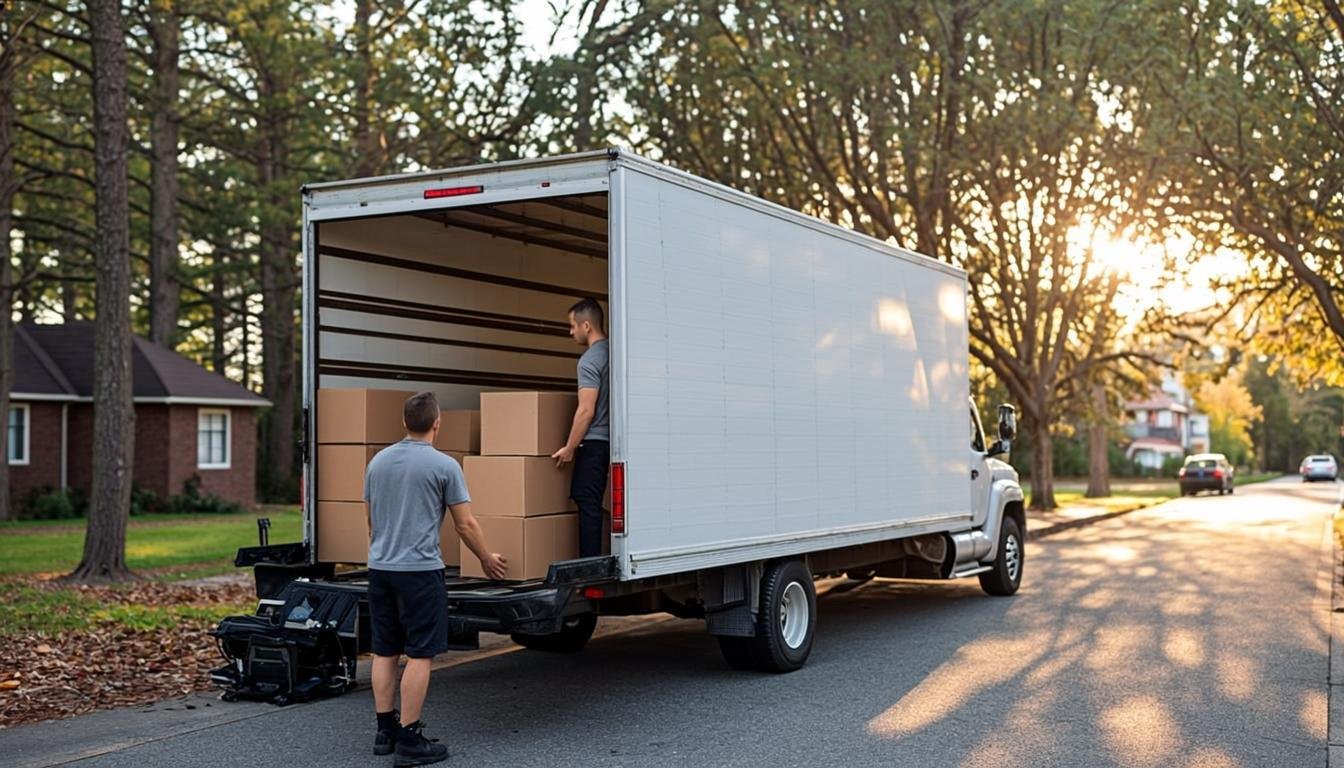
Shipping Methods: Sea Freight vs Air Freight from Atlanta
Every Atlanta to Nigeria shipment ultimately moves on one of two corridors — ocean or air — and the right choice depends on cargo weight, urgency, and budget more than on your suburb. Because both modes consolidate at our Stafford, Texas hub, the method decision and the pickup decision are independent: you can send a mixed shipment (urgent items by air, bulk by sea) in a single pickup visit, with one bill of lading thread and one accountable team from your Atlanta doorstep to the Nigerian one.
Sea Freight from Atlanta to Nigeria (LCL and FCL)
Ocean freight is the value workhorse for Atlanta shippers. LCL (Less than Container Load) consolidation is built for household quantities: barrels, boxed personal effects, palletized goods, and small-business inventory share container space with other Nigeria-bound cargo, and you pay only for the volume you occupy — from $150, with a 6–8 week door-to-door transit including consolidation, Lagos customs clearance, and delivery. Goods sail from the Gulf coast to Apapa or Tin Can Island, Lagos, where SGK’s in-house clearance team (not a third-party agent) handles documentation, examination, and release — typically 48–72 hours when PAAR is pre-arranged.
FCL (Full Container Load) makes sense above roughly 15 CBM or for vehicles and high-value cargo that should travel sealed in an exclusive box. A 20ft container suits a household move or a small commercial lot; a 40ft HC handles full apartment moves, business stock, or two to four vehicles loaded with personal effects around them. FCL is priced per container and runs 28–40 days port-to-port, with exclusive use from our Stafford loading dock to Apapa or Tin Can. If your cargo is commercial in nature — machinery, project cargo, out-of-gauge pieces — flag it at quoting so we route and paper it correctly from the start.
Air Freight from Atlanta to Nigeria
Air freight is the speed play: $4.90/lb to Lagos ($60 minimum), door-to-door with Lagos customs clearance included; $5.30/lb for destinations beyond Lagos. Cargo picked up in Atlanta joins the next weekly air consolidation out of Houston (Tuesday/Wednesday cut-offs), flies into Murtala Muhammed International (LOS), and clears through our Lagos team before doorstep delivery — 3–7 business days port-to-port, typically 1–2 weeks door-to-door including the ground leg, clearance, and delivery. True emergencies can ride express air in 1–3 business days for a premium.
Air rewards dense, well-packed cargo and punishes bulky, light cargo: charges are calculated on the greater of actual or volumetric weight, so compress, vacuum-bag, and pack tight before pickup. Every published air rate already includes standard Lagos customs clearance and end-to-end tracking; cargo insurance (all-risk, up to USD 250,000 per consignment) is available at quoting. Send your item list, weights, and dimensions before booking — we confirm the chargeable weight and the exact all-in number in writing within two business hours.
Shipping Barrels from Atlanta to Nigeria
The half-barrel of foodstuff and household goods is the signature shipment of the Atlanta–Nigeria corridor, and the community ships enough of them that group consolidation has become an institution: churches, hometown associations, alumni bodies, and event committees across DeKalb and Gwinnett collect dozens of drums at a time and move them as one booking. SGK supports both patterns. Individually, we pick up sealed drums anywhere in the metro (or receive your drop-off), label and log each drum into our next LCL consolidation for Lagos, and photograph them at warehouse intake. As a group, we schedule a single consolidation for the whole order, give every member a labeled line on the manifest, and deliver each drum to its own recipient’s door — in Lagos, Abuja, Enugu, Onitsha, Kano, or any of Nigeria’s 36 states.
Barrels travel alongside boxes, pallets, and commercial cargo in the same weekly consolidations, which is why barrel shippers get the same LCL economics as everyone else: from $150 per shipment, 6–8 weeks door-to-door, with clearance and delivery included. Pack foodstuffs airtight (sealed bags inside the drum), distribute weight evenly, and list contents on the packing sheet you hand the driver — accurate declarations are what let personal effects clear under Nigerian baggage rules without Form M. Regular shippers and associations can be placed on a fixed monthly consolidation schedule — contact us for the current per-barrel consolidated rate and group booking terms.
How Much Does It Cost to Ship from Atlanta to Nigeria?
Understanding the full cost of shipping from Atlanta to Nigeria means looking beyond the freight rate alone. The total landed cost includes the pickup leg into our consolidation hub, the ocean or air freight charge, Nigerian customs duties, regulatory fees, terminal handling, and last-mile delivery. Below are SGK Global’s published 2026 door-to-door corridor rates — the same rates a Houston shipper pays — followed by the additional cost components that make up your total landed cost. The only Atlanta-specific line is the origin pickup (quoted per ZIP code, or avoided entirely by dropping cargo at our Stafford, TX warehouse).
| Service | 2026 Rate | Speed | Included |
|---|---|---|---|
| Air freight — Lagos | $4.90/lb · $60 minimum | 3–7 business days port-to-port | Door-to-door incl. Lagos customs clearance |
| Air freight — beyond Lagos | $5.30/lb | 3–7 business days + inland leg | Door-to-door, all 36 states |
| LCL sea freight | From $150 | 30–45 days port-to-port · 6–8 weeks door-to-door | Stafford, TX consolidation + Lagos clearance + delivery |
| FCL 20ft / 40ft | Priced per container | 28–40 days port-to-port | Exclusive container · Apapa / Tin Can clearance |
| Every SGK rate is door-to-door: freight + Lagos customs clearance + delivery. Get yours in writing → request a quote. | |||
Compare landed cost, not headline rates: some low per-pound headline rates stop at the Lagos airport or seaport (port-to-port). Once you add clearing agents, terminal handling, and last-mile delivery, the “cheaper” rate often costs more than a door-to-door quote that already includes Lagos customs clearance and delivery anywhere in Nigeria.
Important: These are estimated rates based on 2026 market conditions. Your total landed cost also includes Nigerian customs duties (typically 5–35% of CIF value by HS code), regulatory certificates (SONCAP / NAFDAC) where applicable, the Atlanta pickup leg, and cargo insurance if elected. Actual costs depend on cargo type, dimensions, weight, declared value, and seasonal demand. Request a free quote from SGK Global for an accurate rate tailored to your shipment.
How Long Does Shipping from Atlanta to Nigeria Take?
Door-to-door transit from Atlanta has two parts: the ground leg into our consolidation hub, and the corridor transit everyone talks about. The ground leg — Atlanta pickup or drop-off trucked to our Stafford, Texas warehouse — typically takes 2–3 business days down the I-20/I-45 freight corridor. From Stafford, your cargo rides the weekly Nigeria-bound services: air consolidations depart Houston with Tuesday/Wednesday cut-offs, and LCL ocean consolidations sail on the weekly Gulf schedule to Apapa or Tin Can.
| Method | Corridor Transit | From Atlanta, Door-to-Door | Best For |
|---|---|---|---|
| Air freight (consolidated) | 3–7 business days port-to-port | Typically 1–2 weeks incl. clearance + delivery | Boxes, urgent goods, 50–1,000 kg |
| Air express | 1–3 business days | Add 2–3 days for the ATL–TX ground leg | Documents, critical parts, pharma |
| LCL ocean | 30–45 days port-to-port | 6–8 weeks incl. consolidation, clearance, delivery | Barrels, household goods, small-business stock |
| FCL ocean | 28–40 days port-to-port | Add the ground leg to the port-to-port figure | Full households, vehicles, exclusive cargo |
| All figures assume complete documentation at cut-off — the single biggest transit variable you control. Full transit-time breakdown → | |||
Three factors move these numbers in practice. First, documentation: cargo with Form M and PAAR processed before arrival clears days faster at Lagos than cargo still assembling paperwork. Second, seasonality: Q4 (October–December) is peak season on every US–Nigeria corridor as the diaspora ships for the holidays — and Atlanta’s community volume is heavy in that surge, so book two to three weeks earlier than usual if your delivery date matters. Third, destination: Lagos deliveries finish fastest; eastern and northern states add a road leg after clearance. SGK tracks every shipment on one thread from Atlanta pickup to Nigerian proof-of-delivery, so you always know which of these variables is affecting your cargo.
Nigerian Customs & Documentation Requirements (2026)
Nigeria’s import regime is documentation-driven, and the paperwork — not the freight — is where most Atlanta shipments lose time. The baseline set is the same regardless of origin state: a Commercial Invoice stating FOB value, descriptions, and HS codes; a Packing List matching the invoice exactly; and a Bill of Lading (sea) or Airway Bill (air). Bona fide used personal effects — the classic barrel-and-boxes shipment — generally clear under Nigerian baggage rules without Form M, which is exactly why accurate content lists matter at pickup.
Commercial imports above USD 1,000 add the regulatory layer: a Form M opened through a CBN-authorised dealer bank before shipment, and a PAAR (Pre-Arrival Assessment Report) so duties are assessed before your container reaches Apapa. Category-governed goods need certificates — SONCAP for regulated electrical and consumer products, NAFDAC for food, cosmetics, and pharmaceuticals — and all filings now run through the 2026 NICIS II digital-only mandate, which removed most walk-in processes. SGK prepares and files all of this as part of the booking: your quote includes documentation guidance, our Lagos team pre-arranges PAAR, and in-house clearance typically completes in 48–72 hours after arrival when the file is complete.
Duties and levies are assessed by Nigerian Customs on CIF value (cost + insurance + freight) using your HS code: commonly 5–35% of CIF for general merchandise, with VAT and levies stacked on top. For a working estimate before you ship anything, use our Nigeria import duty calculator — and when in doubt about a commodity, send us the item list first. It is faster to classify a gray item at the quoting stage in Atlanta than to argue about it at the terminal in Lagos.
What Can (and Cannot) Be Shipped from Atlanta to Nigeria?
Most household and commercial cargo moves freely — foodstuffs, clothing, personal effects, electronics, auto parts, business inventory, machinery. The list that actually gets shipments seized or delayed is the prohibited-and-restricted one, and it catches Atlanta shippers in predictable places. Nigeria prohibits counterfeit currency and goods, pornographic materials, certain used clothing in commercial quantity, specific biosecurity-risk produce, and unregistered pharmaceuticals. Restricted categories — food and beverages (NAFDAC), regulated electrical and consumer products (SONCAP), weapons, live animals — move only with the right permit. Dangerous goods such as lithium batteries, fuels, and aerosols are shippable only when declared and compliantly packed; undeclared batteries inside electronics are the most common air-freight hold-up we see from the metro area.
✅ Ships Freely
- Foodstuffs & household barrels (sealed, listed)
- Personal effects & boxed goods
- Electronics, appliances, auto parts
- Business inventory & commercial stock
- Machinery & equipment (flag at quoting)
⚠ Restricted — Permit / Certificate
- Food & beverages — NAFDAC
- Electrical & consumer products — SONCAP
- Used clothing in commercial quantity
- Dangerous goods — declared, compliant packing
- Live animals — veterinary permits
⛔ Prohibited
- Counterfeit currency & goods
- Unregistered pharmaceuticals
- Pornographic materials
- Biosecurity-risk produce
- Weapons & ammunition
Vehicles deserve a special note because the rules changed: Nigeria has scrapped the vehicle age limit — as of 2026, any model year can be imported, and customs duty is lowest for 2014-model vehicles, with older cars assessed at the same duty rate as a 2014 model. So that project car sitting in a Decatur garage is importable; budget 20–35%+ of CIF value for combined duties, levies, and VAT by engine capacity and type. Vehicles are picked up anywhere in the metro, trucked to Texas, and ride RORO or container from the Port of Houston — see our car shipping from USA to Nigeria guide and the current vehicle import rules before you buy.
Choosing a Freight Forwarder for Atlanta to Nigeria Shipments
Atlanta’s Nigerian corridors are crowded with shipping storefronts that will happily take your barrel — and just as crowded with stories about what happens next: cargo re-handed between anonymous agents, clearance “surcharges” invented at the port, and no one answerable when a drum goes missing. The difference between a storefront hand-off and a freight forwarder is control of the chain. SGK Global is an FMC-licensed NVOCC (verifiable in the FMC’s public database) operating under published tariffs, an IATA-certified cargo agent, and a Nigeria Customs-licensed agent with our own declarants at Lagos — the same company that picks up in Atlanta clears in Lagos and proves delivery at the doorstep.
Before you hand cargo to anyone, ask four questions. One: are you FMC-licensed, and is your tariff published? Two: who performs customs clearance at Lagos — your own licensed team, or a sub-agent you cannot name? Three: is the quote door-to-door with clearance included, or port-to-port with the expensive half left out? Four: what happens when something goes wrong — is there one tracking thread and one accountable company, or a phone tree? Any shipper who cannot answer those cleanly is selling you a hand-off, not a service.
Insurance closes the loop. Every SGK consignment can carry all-risk cover up to USD 250,000, shipments are photographed at warehouse intake, and proof of delivery is issued at the Nigerian doorstep. For a fuller comparison framework — including how corridor rates really stack up — see our guide to choosing the best shipping company from the USA to Nigeria.
Tips to Reduce Your Shipping Costs from Atlanta to Nigeria
Cheap shipping from Atlanta to Nigeria is mostly about packing, timing, and honest declarations — not about chasing the lowest headline number. Start with packing density: air charges ride on the greater of actual or volumetric weight, so vacuum-bag clothing, compress soft goods, and choose the smallest box that protects the contents. On ocean LCL, volume is money: consolidate the family’s barrels and boxes into one booking instead of three, and disassemble furniture so it rides in stacked panels rather than empty air.
Then manage the calendar. Q1–Q2 shipments avoid the Q4 peak-season surge when diaspora volume from the whole metro tightens capacity — if your delivery date is flexible, a January booking routinely beats a December one. Book pickups two to three weeks ahead of your target cut-off so the ground leg to Texas never costs you a weekly sailing. And keep cargo dense where it counts: ocean LCL is priced per CBM, so a tightly packed barrel is materially cheaper than a half-full one occupying the same footprint.
Finally, protect yourself from fake savings. A port-to-port quote that looks $100 lower than a door-to-door one typically turns into a bigger bill once you pay a Lagos clearing agent, terminal handling, and last-mile delivery separately — our published rates already include clearance and delivery, so the comparison is honest before you spend a dollar. Declare contents accurately: undervaluation triggers penalties and exams that cost far more than they save, while bona fide personal effects clear under baggage rules without Form M. For a deeper strategy list, see our guide to the cheapest way to ship to Nigeria from the USA.
Frequently Asked Questions About Shipping from Atlanta to Nigeria
How long does it take to ship from Atlanta to Nigeria?
Air freight from Atlanta to Nigeria takes 3–7 business days port-to-port, with total door-to-door time of approximately 7–17 business days including the 2–3 day ground leg to our Texas hub, customs clearance, and delivery. Ocean freight LCL takes 30–45 days port-to-port with a door-to-door total of 6–8 weeks including consolidation; FCL takes 28–40 days port-to-port. Actual times depend on documentation completeness, port congestion at Apapa or Tin Can, and Q4 peak-season volume.
How much does it cost to ship from Atlanta to Nigeria?
Air freight from Atlanta to Lagos starts at $4.90 per pound ($60 minimum), delivered door-to-door with Lagos customs clearance included; destinations beyond Lagos start at $5.30 per pound. Ocean LCL starts at $150 (6–8 weeks door-to-door) and FCL is priced per container. The Atlanta pickup leg is quoted per ZIP code — or skip it by dropping cargo at our Stafford, Texas warehouse. Nigerian customs duties (typically 5–35% of CIF value) are separate. For an exact all-in number, contact us for a quote.
Do you pick up cargo in the Atlanta metro area?
Yes. SGK picks up across metro Atlanta — Fulton, DeKalb, Cobb, Gwinnett, Clayton, and Cherokee counties, including Clarkston, Stone Mountain, Decatur, Lawrenceville, Marietta, and Roswell. Pickup is scheduled when you book and quoted by ZIP code and cargo size; your cargo then moves on our ground line into our Stafford, Texas consolidation hub (typically 2–3 business days) and onward on the weekly Houston–Lagos services. If you prefer, you can drop cargo at our Stafford warehouse instead and pay no origin pickup.
Can I ship barrels of foodstuff from Atlanta to Nigeria?
Yes — the foodstuff barrel is the signature shipment on this lane. We pick up sealed drums across the metro (or receive drop-offs), label and log each drum into our next LCL consolidation for Lagos, and deliver door-to-door in Lagos, Abuja, Enugu, Onitsha, Kano, or any of Nigeria’s 36 states. Barrels ride the same LCL economics as other cargo — from $150 per shipment, 6–8 weeks door-to-door, clearance and delivery included. Churches and hometown associations across DeKalb and Gwinnett run group consolidations with us on fixed monthly schedules. Contact us for the current per-barrel consolidated rate.
Can I ship a car from Atlanta to Nigeria?
Yes. We pick the vehicle up at your Atlanta address, truck it to our Texas hub, and ship it by RORO or inside a container from the Port of Houston to Lagos. Nigeria no longer enforces a vehicle age limit — any model year can be imported as of 2026, with duty lowest for 2014 models and older vehicles assessed at the same duty rate as a 2014 model. You will need the vehicle title, Bill of Lading, Form M for commercial imports, and proof of SONCAP compliance. Import duty on vehicles ranges from 20–35%+ of CIF value depending on type and engine capacity.
What is the cheapest way to ship from Atlanta to Nigeria?
Ocean LCL is the cheapest legitimate method for most Atlanta shipments, starting at $150 door-to-door — you share a container to Tin Can Island and pay only the volume you occupy. Above roughly 15 CBM, a full container priced per box may be cheaper per unit. To cut cost further: pack dense (air charges follow volumetric weight), combine barrels and boxes into one booking, ship in Q1–Q2 instead of the Q4 peak, and declare accurately to avoid customs penalties. See our cheapest-way guide for the full strategy list.
What documents do I need to ship to Nigeria from Atlanta?
The standard documents are a Commercial Invoice, Packing List, and Bill of Lading (sea) or Airway Bill (air). Commercial imports above USD 1,000 also need a Form M filed through a CBN-authorised dealer bank and a Pre-Arrival Assessment Report (PAAR). Regulated goods add SONCAP (electronics and consumer products) or NAFDAC (food, cosmetics, pharmaceuticals) certificates, and all filings comply with the 2026 NICIS II digital-only mandate. Bona fide used personal effects generally clear under Nigerian baggage rules without Form M. SGK prepares and files all of this with your booking.
Which items cannot be shipped from Atlanta to Nigeria?
Nigeria prohibits counterfeit currency and goods, pornographic materials, unregistered pharmaceuticals, certain used clothing in commercial quantity, biosecurity-risk produce, weapons, and ammunition. Restricted categories — food and beverages (NAFDAC), regulated electrical and consumer products (SONCAP), live animals — require permits. Dangerous goods such as lithium batteries, fuels, and aerosols move only when declared and compliantly packed; undeclared batteries inside electronics are the most common air-freight hold-up we see from the metro area. Send us the item list before booking if you are unsure.
Why ship with SGK instead of an Atlanta shipping store?
Because of who controls your cargo after pickup. SGK is an FMC-licensed NVOCC with published tariffs (verifiable in the FMC’s public database), an IATA-certified cargo agent, and our own Nigeria Customs-licensed declarants at Lagos — the same company picks up in Atlanta, clears at Apapa or Tin Can, and proves delivery at the doorstep, on one tracking thread. Every rate is door-to-door with Lagos clearance included, all-risk insurance up to USD 250,000 is available per consignment, and shipments are photographed at warehouse intake. A storefront hand-off cannot answer for the half of the journey it does not control.
Ready to Ship from Atlanta to Nigeria?
Get a free, no-obligation quote for your shipment. SGK Global’s Atlanta pickup network, Texas hub, and Lagos team handle your cargo from doorstep to delivery — with transparent pricing, real-time tracking, and FMC-protected payments.
Or call us: +1-281-501-2922
Related Reading
- Shipping from Texas to Nigeria: 2026 Rates & Transit Times
- Shipping from Houston to Nigeria: 2026 Rates & Transit Times
- Shipping from New York to Nigeria: 2026 Rates & Transit Times
- Best shipping company USA to Nigeria
- Car shipping from USA to Nigeria
- Shipping from Miami to Nigeria: 2026 Rates & Transit Times
- Shipping Barrels to Nigeria: 2026 Price Guide