

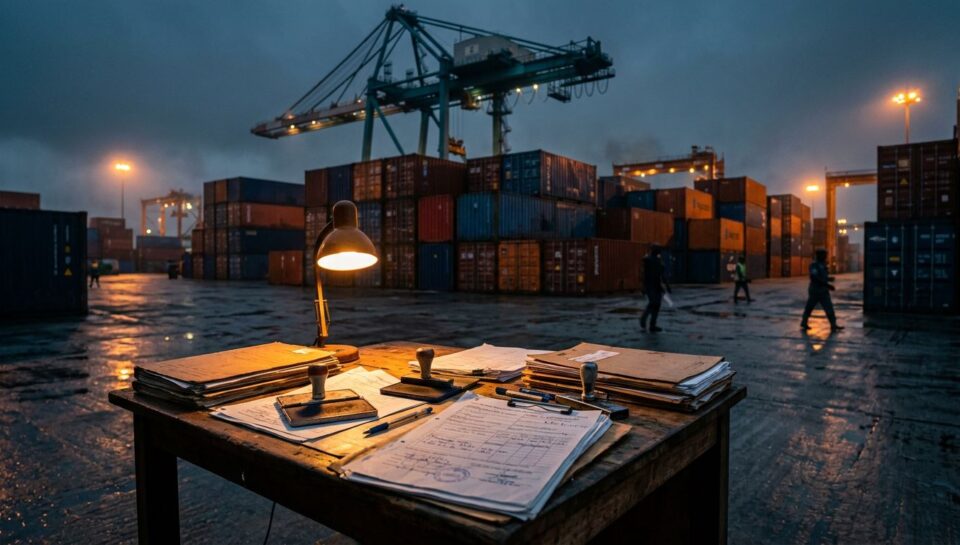

Customs Clearance Nigeria — Licensed Brokerage at Apapa, Tin Can & Onne
Customs clearance Nigeria services from SGK Global — a licensed customs broker with an in-country Lagos team that processes your cargo daily at Apapa, Tin Can Island, Onne Port, and Lagos airports. We handle Form M, PAAR, duty assessment, SON and NAFDAC compliance, and cargo release — so your shipment clears faster and you avoid demurrage. Part of our complete USA to Nigeria shipping service.
How Customs Clearance Works in Nigeria
Nigerian customs clearance is a multi-step process governed by the Nigerian Customs Service (NCS) under the ECOWAS Common External Tariff (CET). Understanding this process is essential because delays at the customs stage are the single biggest cause of unexpected costs for importers — primarily through demurrage charges at the port terminal. When you work with a licensed customs broker like SGK Global, we manage every stage on your behalf, but it helps to know what is happening with your shipment at each point.
- Pre-arrival filing — Before your vessel or flight arrives, SGK files the Form M through your Nigerian bank and obtains the PAAR (Pre-Arrival Assessment Report). This is the risk assessment and duty classification performed by NCS based on your declared goods, values, and HS codes. Starting this process early is critical — vessels are not even supposed to berth without a valid PAAR.
- Document submission — When the vessel arrives, we submit your complete documentation package to NCS: Bill of Lading or Airway Bill, Commercial Invoice, Packing List, Form M with RA Number, PAAR, and any product-specific certificates (SON/SONCAP, NAFDAC). Missing or inconsistent documents are the most common cause of clearance delays.
- NCS examination — Customs officers may select your shipment for physical examination to verify that the actual contents match the declared goods. Not every container is examined — NCS uses a risk-based selection system — but if your shipment is selected, SGK’s team coordinates the examination to minimise delay.
- Duty assessment and payment — NCS issues the final duty assessment based on CIF value and the applicable HS code tariff rate. SGK reviews the assessment for accuracy, disputes any incorrect classifications, and facilitates duty payment on your behalf.
- Cargo release — After duty payment and examination clearance, the terminal releases your cargo. SGK arranges door-to-door delivery from the port to your address in Lagos, Abuja, Port Harcourt, Onitsha, or any other city in Nigeria.
Documents Required for Customs Clearance in Nigeria
One of the most searched queries around customs clearance Nigeria is about documentation — what papers you need, who prepares them, and what happens if they are incomplete. Below is the complete checklist of documents required for clearing goods through Nigerian Customs, along with notes on SGK’s role in each. Our customs clearance service includes reviewing and preparing your documentation package before submission to prevent the most common causes of delay.
Form M (RA Number)
Nigeria’s mandatory import registration form, filed through an authorised dealer bank. Required for all commercial imports above $1,000 CIF. Generates the Registration Number that must appear on all shipping documents.
SGK assists with preparationPAAR (Pre-Arrival Assessment Report)
Risk assessment and duty classification issued by NCS after Form M is approved. Must be obtained before the vessel arrives. PAAR determines the duty rate applied to your goods.
SGK files and monitorsBill of Lading / Airway Bill
Title document for the shipment. As an FMC-licensed NVOCC, SGK issues our own House Bills of Lading — no dependency on third-party carriers for document release.
SGK issues directlyCommercial Invoice
Detailed invoice showing the value, quantity, and description of goods. Must match the Form M and PAAR values exactly. Inconsistencies trigger customs queries and delays.
SGK reviews for accuracyPacking List
Itemised list of the contents of each package, including weight and dimensions. Used by NCS during physical examination to verify cargo against the declaration.
Shipper provides; SGK reviewsSON / SONCAP Certificate
Required for regulated products including electronics, machinery, and building materials. The Standards Organisation of Nigeria conformity assessment proves product safety and quality compliance.
SGK coordinates certificationNAFDAC Certification
Required for all food, drugs, medical devices, and cosmetics imported into Nigeria. NAFDAC may hold shipments for product testing if certification is not pre-arranged — causing weeks of delay.
SGK coordinates with NAFDAC agentsCombined Certificate of Value & Origin
Declares the origin and value of the goods for tariff classification purposes. Required for imports from non-ECOWAS countries, including the United States.
SGK preparesNigeria Import Duties & Customs Fees Explained
Understanding how Nigeria customs duties are calculated is essential for forecasting your total landed cost. Many importers are surprised by the final amount because they did not account for all the charges that stack on top of the basic import duty. Nigeria uses the ECOWAS Common External Tariff (CET), which means duty rates are standardised across West Africa — but the calculation method includes multiple layers that can significantly increase your total payable amount.
Here is how Nigerian customs duties are calculated on a standard commercial import:
| Charge | Rate | Calculated On |
|---|---|---|
| Import Duty | 5% – 35% | CIF value (Cost + Insurance + Freight) — rate depends on HS code |
| VAT | 7.5% | CIF value + Import Duty + other surcharges |
| CISS Levy | 1% | CIF value — Comprehensive Import Supervision Scheme |
| ETLS Levy | 0.5% | CIF value — ECOWAS Trade Liberalisation Scheme |
| NAFDAC Fee (if applicable) | Variable | Based on product category — food, drugs, cosmetics |
| SON Fee (if applicable) | Variable | Based on product category — electronics, machinery |
Sample Duty Calculation — 5kW Generator from USA
CIF value: $2,000 · HS Code: 8501.63 — Duty rate: 20%
Duty rates are subject to change. SGK’s team will provide a precise estimate based on your specific shipment and current NCS tariff schedules.
The effective total duty and tax rate on this generator works out to approximately 30.6% of CIF value — significantly more than the headline 20% import duty rate alone. This stacking effect catches many first-time importers off guard, which is why SGK Global provides estimated duty calculations before you ship, so there are no surprises when the final assessment arrives. Our procurement services can also help you source from US suppliers at the best FOB prices, giving you better control over your CIF value and therefore your duty burden.
Ports We Clear Through
Not all Nigerian ports operate the same way, and choosing the right port for customs clearance Nigeria can affect your timeline and cost. SGK Global’s customs brokerage covers every major seaport and airport in Nigeria, with particular depth at the Lagos ports where the vast majority of US-origin cargo arrives.
Apapa Container Terminal, Lagos
Nigeria’s largest port and the primary entry point for containerised cargo from the US. Congestion is the main challenge — during peak periods, vessels wait 3–7 days to berth, and the terminal fills quickly. SGK’s daily presence here means we process clearance documents as soon as the vessel manifest is filed, minimising your post-berth clearance time.
Tin Can Island Port, Lagos
Often faster than Apapa for container clearance, and the preferred port for RoRo vehicle imports. When Apapa is congested, ocean freight carriers may reroute to Tin Can. SGK processes clearance at both Lagos ports interchangeably.
Onne Port, Port Harcourt
The designated oil and gas free zone port. Customs clearance at Onne has different procedures for O&G cargo entering the free zone versus general commercial imports. SGK has specific experience with Onne’s free zone documentation requirements.
Lagos Airports (LOS)
Customs clearance at Murtala Muhammed International Airport for air freight shipments is typically faster than sea port clearance — 2–5 working days. SGK coordinates airport clearance for time-critical cargo.
How Long Does Customs Clearance Take in Nigeria?
Clearance timelines depend on the mode of transport, the port, the cargo type, and the completeness of your documentation. Below are typical ranges based on SGK Global’s experience processing thousands of Nigeria-bound shipments.
| Mode / Port | Typical Clearance Time | Common Delay Causes |
|---|---|---|
| Sea Freight — Apapa | 5–15 working days | Port congestion, NCS examination backlog, incomplete documents |
| Sea Freight — Tin Can | 5–12 working days | Less congestion than Apapa; RoRo vehicles clear faster |
| Sea Freight — Onne | 5–10 working days | O&G free zone procedures; fewer competing shipments |
| Air Freight — Lagos | 2–5 working days | NAFDAC or SON hold on regulated products |
| Air Freight — Abuja / PHC | 2–5 working days | Limited cargo flight schedules; smaller processing teams |
The biggest factor within your control is document completeness and accuracy. Shipments with consistent, complete documentation clear significantly faster than those with discrepancies that trigger NCS queries. The second factor is pre-arrival processing — filing Form M and obtaining PAAR before the vessel arrives means clearance can begin immediately upon berthing, rather than waiting days for paperwork to be processed. SGK Global’s standard practice is pre-arrival filing on every shipment we handle, which is one of the reasons our clearance times are consistently at the lower end of these ranges. Our warehousing and storage facility in Houston also ensures your cargo is properly consolidated and documented before shipping, reducing the risk of customs discrepancies on the Nigeria side.
Why Use a Licensed Customs Broker?
Some importers consider handling customs clearance themselves to save on broker fees. In the customs clearance Nigeria context, this is almost always a false economy. The Nigerian customs process is opaque to outsiders — procedures change frequently, duty classifications are complex, and the consequences of mistakes range from costly delays to cargo seizure. Here is why using a licensed customs broker like SGK Global is the pragmatic business decision.
Licensed Customs Broker (SGK Global)
Daily port presence means immediate document processing. Pre-arrival filing ensures PAAR is ready before the vessel. Duty classification expertise prevents overpayment. Established relationships with NCS officers reduce examination delays. Demurrage risk is minimised because clearance starts on day one. You have one point of contact for the entire process.
Self-Clearing or Ad-Hoc Agent
No pre-arrival filing — clearance starts only after vessel arrives. Unfamiliarity with current duty rates leads to overpayment or disputes. No daily port presence means documents sit in queues. Reliance on agents who handle many clients means your shipment is not a priority. Demurrage charges accumulate while you navigate the process. No accountability if the agent makes an error.
SGK Global operates as both a licensed customs broker and an FMC-licensed NVOCC — a dual credential that means we control the entire chain from the moment your cargo leaves the US supplier until it is released from Nigerian customs. Proper packaging and crating at our Houston warehouse also reduces the risk of NCS examination delays caused by damaged or improperly labelled cargo. We do not hand off the Nigeria leg to a third-party clearing agent we have never met. Our Lagos team works directly for SGK Global, processes your documents daily at Apapa and Tin Can, and is accountable to us — which means they are accountable to you.
Frequently Asked Questions
Get Your Cargo Cleared — Talk to Our Team
Whether you are importing commercial goods, clearing personal effects, or need customs brokerage at Onne Port for O&G equipment — SGK Global’s licensed customs clearance Nigeria team is ready. Get a free, no-obligation quote in under 24 hours.
Get a Customs Clearance Quote Call us: +1-281-501-2922 | Register with us | Track your shipment